Power continuity has become a critical operational requirement across industries. Data centers, industrial facilities, healthcare environments, commercial buildings, and digital infrastructures increasingly depend on uninterrupted, high-quality electrical power to maintain productivity and prevent costly downtime.
When selecting an Uninterruptible Power Supply (UPS), businesses often compare two advanced technologies: Online UPS and Modular UPS. While both provide continuous power protection through double-conversion technology, they differ significantly in terms of architecture, scalability, redundancy, maintenance, and long-term performance.
Understanding these differences can help organizations choose a UPS solution that aligns with their operational needs, growth plans, and infrastructure strategy.
An Online UPS, also known as a True Online Double Conversion UPS, continuously processes incoming utility power before supplying it to connected equipment.
The operating principle consists of three stages:
1. Rectification – Incoming AC power is converted into DC power.
2. Energy Conditioning and Battery Integration – The DC power supplies the DC bus while simultaneously charging the batteries.
3. Inversion – DC power is converted back into a stable and regulated AC output for connected loads.
Since the load is always powered through the inverter, there is zero transfer time during power disturbances or outages.
Online UPS systems protect connected equipment from common power quality issues such as:
Modern Online UPS systems typically offer:
These features make Online UPS systems ideal for environments where power quality is critical.
A Modular UPS utilizes the same double-conversion technology but adopts a completely different design approach.
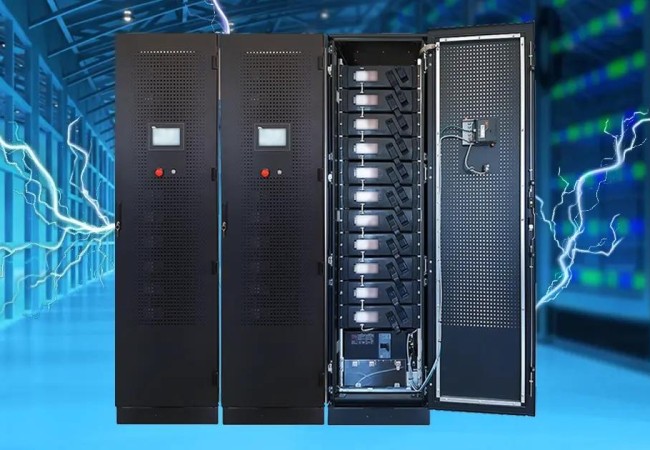
Instead of relying on a single centralized power block, a Modular UPS consists of multiple independent power modules installed within a common frame.
Each module contains its own:
All modules operate in parallel to support the critical load.
A 300 kVA UPS system may be configured using six 50 kVA modules. As power requirements grow, additional modules can be added without replacing the entire UPS infrastructure.
This design provides horizontal scalability, allowing businesses to expand capacity gradually rather than investing in oversized systems from the beginning.
One of the most significant benefits of a Modular UPS is N+1 redundancy.
For example:
The extra module serves as a backup. If one module fails, the remaining modules continue supporting the load without interruption.
This dramatically increases system availability and minimizes operational risks.
Although both technologies provide continuous power protection, their operational characteristics differ substantially.
Online UPS
Modular UPS
Online UPS
Traditional Online UPS systems often require businesses to purchase additional capacity upfront to accommodate future growth. Upgrades may involve replacing the entire system or installing additional parallel UPS units.
Modular UPS
Capacity can be expanded simply by adding new power modules as needed, reducing unnecessary upfront investment.
Online UPS
Maintenance activities may require bypass operations or scheduled downtime depending on system configuration.
Modular UPS
Individual modules can be serviced, replaced, or upgraded while the system remains operational, minimizing disruption to critical loads.
UPS efficiency changes according to load percentage.
Online UPS
Large centralized systems may operate less efficiently when running significantly below their rated capacity.
Modular UPS
Modules can be activated or deactivated based on demand, helping maintain higher efficiency levels across varying load conditions.
This results in:
When selecting a UPS solution, businesses should evaluate more than just the initial purchase price.
For facilities with stable and predictable power requirements, Online UPS systems often provide a lower initial deployment cost.
Although the initial investment may be higher, Modular UPS systems frequently deliver stronger long-term value through:
Organizations operating 24/7 can achieve significant savings over the system lifecycle.
Common Applications:
Common Applications:
Both Online UPS and Modular UPS technologies are designed to deliver uninterrupted power and protect critical systems from utility disturbances. However, they address different operational requirements.
An Online UPS provides proven reliability, stable power conversion, and cost-effective deployment for fixed-load environments.
A Modular UPS offers greater scalability, redundancy, maintainability, and long-term adaptability, making it ideal for rapidly evolving infrastructures.
The right choice depends on your current power requirements, future growth plans, redundancy objectives, and overall business strategy. A well-designed UPS solution should not only protect your operations today but also support tomorrow’s expansion without compromising availability or performance.


POWERON ENERTECH INDUSTRIES UK LIMITED
Unit No. #03 21 Dover Road,
Blackpool, England, FY16PN,
United Kingdom
Cookies may be used on this site and stored on your device to enhance site navigation, analyze site usage, enable troubleshooting session recording for optimized customer support resolution, and assist in our marketing efforts. More info
 Login
Login